I recently attended the Colorado River Water Users Association conference in Las Vegas, where there was a big blue-carpeted room for vendors in the water space to hawk their wares and advertise their services.
There were people selling irrigation equipment, state-of-the-art canal lining technology, monitoring software — anything a farmer or water district administrator or municipal water manager might want. Anything except, perhaps, a solution to decades-long drought.
Well, there was one vendor who tried to broach that issue.

Tucked in the corner of a hall, there was a booth emblazoned with logos for a cloud seeding company. Intrigued, I walked over and started talking to the company representative.
Wait, so, is this, I don’t know, real? I asked.
Very real, he assured me. Not science fiction. There are studies. Particles of silver iodide are dispensed in clouds, where they act as nuclei around which ice forms. (Forgive me for poorly stating the science. It has something to do with…lattice structures?)
Well, surely it must be too costly or logistically difficult to deploy at scale, no? I replied.
Not these days, he said. States across the West fund cloud seeding programs (nine of them, with Utah leading the charge as early as the 1950s, according to the North American Weather Modification Council).
Huh. Good to know! I said before wandering off.
I did a little checking. Arizona doesn’t have such a program, though the Salt River Project and the state have put some cash toward studies in the past. There was also an experiment financed by the Pinal County Water Augmentation Authority last year; officials with the agency said cloud seeding near Casa Grande yielded 134,192 acre feet of water at $3 an acre foot, though the meteorologist who oversaw the project and reported the results works in the cloud seeding industry. Officials also acknowledged this was a rough, and possibly overoptimistic, estimate.
I made a mental note. Clearly I was not hip to the latest research. But if Utah Gov. Spencer Cox can pray for rain (and if his state can try to seed it), I suppose we can put our faith in science. Right?

Lo and behold, a couple months have passed, the legislative session has begun, and now lawmakers are moving legislation that would allow monies from the state Water Infrastructure Finance Authority to fund “snowpack augmentation projects.”
In other words, they want to use cloud seeding to increase snowfall, which apparently is a more efficient way to generate water than seeding raindrops.
The bill is sponsored by Republican Rep. Gail Griffin, the chair of the House Natural Resources, Energy and Water Committee, and one of the lawmakers with the most control over water policy at the Capitol.
“We’re hoping that this is just another tool we can use in our water toolbox,” she said in a meeting of that committee in January.
The bill, HB2024, passed out of the Natural Resources Committee on a 6-4 margin and now awaits approval from the full House. Lawmakers from both parties raised moral and practical issues with altering the weather to address the drought — though all committee Republicans ultimately voted for the measure. Indeed, GOP Sen. John Kavanagh has sponsored a bill to ban chemically induced weather modification, but he has said he would amend his proposal to allow for cloud seeding. Kavanagh’s bill, SB1098, awaits committee action.
Testifying in support of the proposal in January was Shawn Martini, a representative of Rainmaker Technologies Corp., a startup that already has cloud seeding contracts with seven states across the West, though the bulk of the company’s work is concentrated in Utah, Martini said. The firm’s clients include water conservancies, irrigation districts, and state governments themselves, to name a few, he said. (Rainmaker also employs Bria DeCarlo, the meteorologist from the Pinal County cloud seeding trial).
“What we do at Rainmaker is make water more abundant through the application and deployment of next-generation cloud seeding technology across the West,” he told lawmakers.
The technology itself is old. But Martini said Rainmaker is bringing new tools to the trade, using drones to more efficiently deploy and monitor the silver iodide.
"At Rainmaker, we spend a lot of time thinking about water and how the conversation and mindset is always one of scarcity and doing less with less,” he told the committee. "And hopefully with the application of this technology, we can shift the conversation and the mindset from one of scarcity to one of abundance and at a minimum additionality.''
Capitol Media Services' Bob Christie reported that the company had previously approached WIFA about funding, but were told they would need to be a water provider to qualify. The company would still need to partner with a provider to receive funds from WIFA, but Griffin’s bill would at least make such an arrangement possible.
Specifically, the bill would allow firms like Rainmaker to access a revolving fund generally used for rural water projects. The fund received a $200 million appropriation in 2022, less than half of which has been spent, Christie reported.
Martini is a seasoned government affairs professional with past clients like Chevron and the Colorado Farm Bureau Federation. But it’s perhaps worth noting that the founder of Rainmaker is a Zyn-gumming, steak-eating 20-something named, improbably, Augustus Doricko, as profiled in this excellent piece from Business Insider. (I realize that I am a 29-year old named Arren Kimbel-Sannit).

The firm is part of a community of firms clustered in El Segundo, California, or “Gundo,” where young founders are blending masculinity, Christianity, and gym culture into a heady brew of defense and defense-adjacent “hard tech” designed to save the West, per this wild story from Vanity Fair’s Zoe Bernard.
Bernard writes: “’We’re pollinating different ideas,’ Augustus Doricko, the founder and CEO of the cloud-seeding company Rainmaker, which raised $6.3 million from venture capitalists in May, tells me. ‘We’re sick of nihilism and goofy software products.’ Behind him, on Rainmaker’s office wall, hangs an American flag the size of a dumpster. Opposite is a life-size poster of Jesus Christ smiling benevolently onto a bench press below. ‘Right now,’ he adds, ‘Gundo is for hard tech what Florence was for art during the Renaissance.’”
So what does the research actually say?
It’s a mixed bag, though cloud seeding is indeed not science fiction.
A recent review of existing studies from the federal Government Accountability Office found results ranging from 0% to 20% additional precipitation, though it noted difficulty in evaluating efficacy of the technology from the relatively small number of existing studies. It also reported that existing research does not show notable or environmental health impacts from silver iodide, though several environmental groups oppose cloud-seeding programs along those lines, arguing we don’t know enough to accept the risk for uncertain gain. (Locally, the Arizona chapter of the Sierra Club and other conservation groups are opposed to Griffin’s bill, while Rainmaker and several agriculture groups are in support of it).
“Reliable information is lacking on the conduct of optimal, effective cloud seeding and its benefits and effects,” the GAO said. “Without such information, operations will be less effective and the return on funding investments is unclear.”
The Colorado River District, which operates a cloud seeding program along the northern and central Rocky Mountains, reports that cloud seeding can increase snowfall by up to 15%, which “could equal up to 80,000 acre-feet of water annually once it melts.”

That’s a drop in the bucket in terms of the multi-million acre-foot deficit in the Colorado River Basin, which raises a fundamental point: There’s a concept in the sciences and public policy of a “technological fix” — “a means for resolving a societal problem by adroit use of technology and with little or no alteration of social behavior,” to quote Alvin Weinberg, the physicist who arguably coined the term. In a talk he delivered to an energy industry symposium in the 1970s, he gave the following example — one that might be illustrative of our current water situation:
“In principle, it is easier to increase the efficiency of a central station power plant — say by installing low Btu gas topping cycles — than it is to persuade millions of people to turn off their lights or to insulate their homes,” he said. “In the one case — increasing efficiency of supply — the ultimate consumer has little reason to change his style of living; in the other case, his customary habits are intruded upon, and he must readjust at least some of his ways of doing things.”
In other words, it’s easier to embrace technological solutions than it is to modify social behavior or address societal ills of inequality, waste and natural exploitation.
This doesn’t mean we shouldn’t innovate, of course, and every drop helps.
Elsewhere in the southwestern water world, we’re talking about future-looking water recycling technology, as we should be.
But heading off systemwide collapse in the Colorado River basin will likely require curtailing demand and consumption, not just adding supply — social innovations, not technological ones.
So we should question anyone or anything that promises abundance without behavioral change.

With friends like these: Mexico has agreed to send at least 350,000 acre-feet of water per year from the Rio Grande to the United States as part of a binational deal announced earlier this month, per Reuters. The deal follows tariff threats from the Trump administration, which claims missed water deliveries from the country in the past have dried out Texas farmers. The two countries reached an agreement under the framework of a 1944 treaty that also governs deliveries from rivers including the Colorado to Mexico.
“The agreement reached makes it possible to strengthen the orderly management of water resources in the Rio Grande basin and to move toward planning with greater predictability and shared responsibility in the face of the effects of drought,” the Mexican foreign ministry told the outlet.

With friends like these, Pt. 2: Utah’s Legislature is considering a $1 million appropriation for state litigation related to Colorado River negotiations, just as Arizona and other states in the basin have done recently.
Bandaids and bad hydrology: There’s a chance that the seven states of the Colorado River basin may reach a short-term deal to govern the river even as the upper and lower divisions of the states remain at odds over the region’s long-term future. KJZZ’s Alex Hager asks: Is a short-term deal enough to forestall systemic collapse?
“A five-year deal seems like it would be tight, but a five-year deal is better than no deal,” Katherine Tara, a water policy analyst at the University of New Mexico, told Hager. “Coming to a deal, even if it's a five-year deal, gives people who drink the water and irrigators, farmers, folks working in agriculture, you know, guaranteed minimum water deliveries, which is crucial.”
Not business as usual: Arizona Chamber of Commerce President Danny Seiden is backing the state’s position in Colorado talks, writing in a recent statement for Chamber Business News that as federal officials consider new rules for managing the Colorado River after 2026, Arizona is being asked to shoulder more than its fair share of the cuts.
“That is not acceptable, and we need our state’s leaders across both political parties to step up and aggressively push back.”
You can aggressively push back on cuts to water news by supporting the Water Agenda.
Thirsty for leadership: Scottsdale’s water department got a new director in David Walby after the city’s longtime water guru, Brian Biesemeyer, retired, and his replacement didn’t last long, the Scottsdale Progress’ Tom Scanlon writes. City Council member Solange Whitehead argues their trouble keeping water talent boils down to it’s troubled political waters.
“Water professionals have told me that City Hall politics are driving staff losses… and hindering efforts to attract new water talent,” Whitehead said.

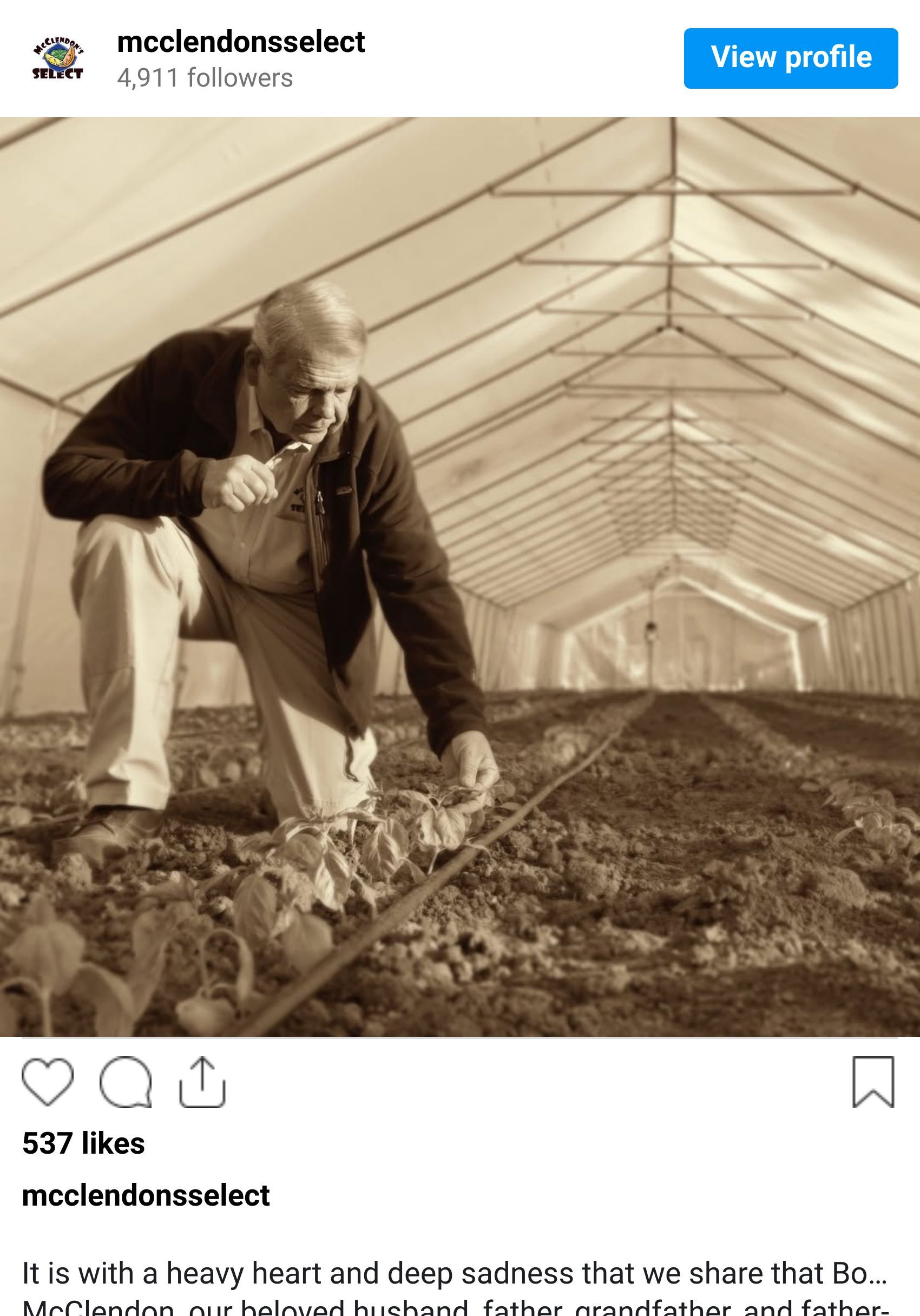
Bob McClendon, a pioneering organic farmer whose produce has proliferated Arizona markets and restaurants over the years, has died, his family announced this week. “Constrained only by the elements and his suspenders, he took a patch of dusty desert and turned it into a bountiful paradise,” the farm he founded, McClendon’s Select, posted on Instagram.